
Count office trips before comparing home locations
A hybrid schedule changes how often you travel, but it does not make every route equally important. Write down the days you usually go in, how often that pattern changes, the time you need to arrive, and where the office entrance is. Include client visits or other regular trips if they matter. A home that works for a remote day may still create a difficult office-day commute.
Ask your employer what is fixed and what can change, then use a realistic range instead of assuming your current schedule will never move. Do not choose a home based only on a future policy that has not been confirmed. If your role includes several work locations, test each one you visit regularly.
Evaluate the home workspace as part of the property
Look for a room or area with a door, workable light, outlets, and enough space for your equipment. Consider where calls happen, how household activity intersects with that room, and whether another use must share it. A dining table can be a short-term solution but may not fit every schedule or type of work.
Check internet availability and service options for the exact address with providers. Ask about mobile signal in the rooms you plan to use. A listing does not verify connection speed, current plan availability, or whether a network meets your employer's requirements. Confirm the facts before treating remote-work readiness as a property feature.
Test the route on an office day
Use the actual address and office location. Check transit, parking, driving, and the walk from the stop or garage to the workplace. Verify current schedules directly with the transit provider; the MBTA trip planner can help you compare current options. Include the return trip and any transfer or last-mile connection.
Try a route at your expected arrival time if you can. Record the date, weather or service conditions, and how much flexibility you had. One trial cannot predict every commute, but it can expose a missed connection, awkward parking, or an underestimated walk. If you only travel occasionally, consider whether a backup option is available when a train, ride, or car plan changes.
Compare a week's rhythm instead of a map radius
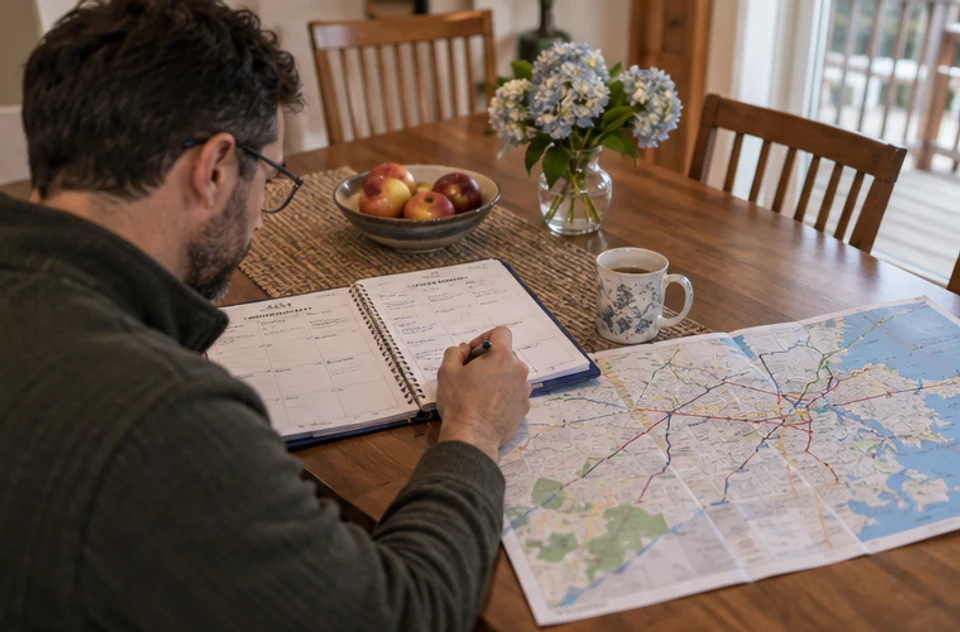
Make a weekly calendar with office days, home days, errands, appointments, and regular personal commitments. For each property, estimate only the travel you can verify and note where an assumption remains. A place that appears close on a map may be less convenient for the door-to-door route; a longer trip may be manageable if it happens less often. Your own schedule determines which difference matters.
At the same time, compare the home's layout, maintenance, parking, and total monthly cost. A flexible workspace may require another room or a different floor plan. A larger home can create additional upkeep. Consider the budget and maintenance as carefully as the commute rather than ranking addresses by distance alone.
Keep your route notes tied to a property
For each address, record the nearest usable transit option, full office route, expected travel times, parking question, and home workspace. Confirm current service with providers and costs with your lender or other qualified advisor. Do not use an old schedule or a generic commute estimate as a promise about future service.
The comparison tool below lets you rate homes against the routes and workspace needs you entered. Talk with Rita about a MetroWest search around your work routine. She can help organize tours in Natick, Framingham, Wellesley, and nearby towns; employers and transit providers confirm current schedules, and your lender reviews the financing plan.
Build a backup into the decision
Ask what happens if the office-day pattern changes, a route is disrupted, or you need to work from home more often. Consider a workspace that can adapt and at least one alternate travel option, if available. A backup is not a guarantee, but it can help you compare how much schedule risk you are comfortable carrying.
Before an offer, check the address, route, service information, internet provider, and property records again. Hybrid work makes the home and commute part of one decision. A dated, address-specific comparison can keep that choice grounded as your routine changes.